Den Otter, born in 1955 in Poortugaal (The Netherlands), started the series World Stress Paintings in 2010. Up to July 2014 it consists of the large number of 164 paintings. In the exhibition in Utrecht and also in the accompanying book 150 examples are shown. All paintings are tempera on paper, 18 x 26 cm. The paintings are based on photographs taken by Den Otter himself or from magazines and papers.
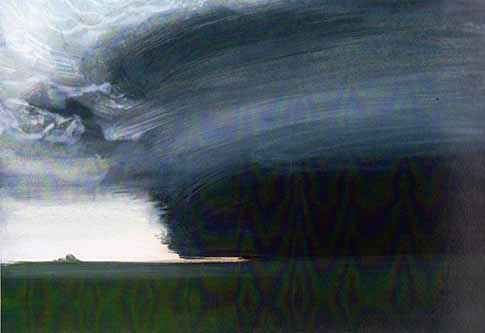
Olphaert den Otter, World Stress Painting: Air 27.10.11
All paintings depict catastrophes. Den Otter has one very concrete criterion for the catastrophe suitable to be part of the series: it should be a combination of human act and nature. Hence scenes of war, war crimes, demonstrations, explosions or accidents are qualified to be motifes, whereas a volcano eruption, an earthquake or a tsunami doesn’t, unless a human participation can be made visible, like in the case of Fukushima, the Japanese nuclear power plant, destroyed by an earthquake.
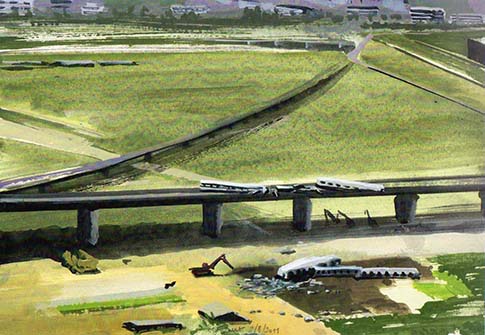
Olphaert den Otter, World Stress Painting: Earth 2.8.11
The photographs are only a starting point. In the paintings for instance there is no human presence. Human beings depicted in the photographs will be mostly either culprit or victim. Since in the opinion of Den Otter the World Stress Paintings deal with man in general, and not with particular human beings, he prefers to leave out all human presence. ‘Humans disturb the image’ as he said in a recent interview for Dutch radio.
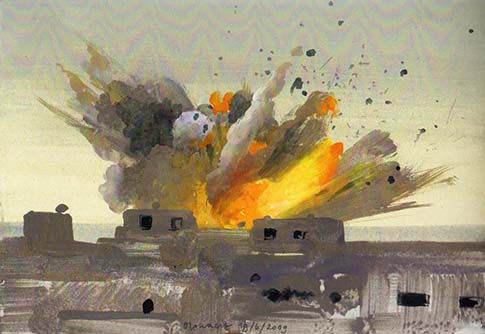
Olphaert den Otter, World Stress Painting: Fire 19.6.09
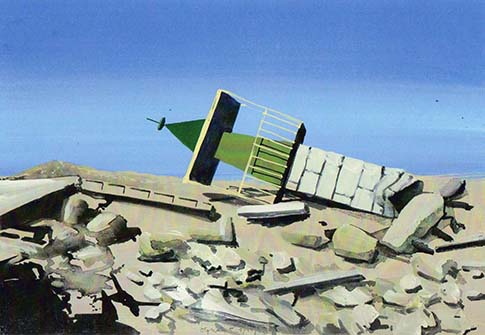
Olphaert den Otter, World Stress Painting: Fire 1.11.10
The paintings are classified according to the four elements (water, air, earth and fire) or to a combination of those. Again these are super-human criteria. Traditionally the physical world consists of these four elements. In Den Otter’s view the demolition of the world is ‘made’ from these four elements as well. As he pointed out in the same interview he was raised in a period in which everything seemed possible. It was the heyday of the doable, achievable world. The 1972 report of the Club of Rome The Limits of Growth changed all this. Instead of victim of calamities, such as extreme rainfall or droughts, man was culprit and guilty, the initiator of climate change.
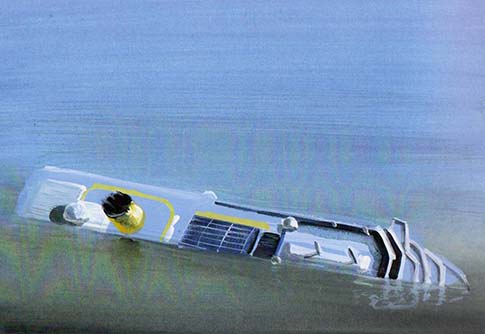
Olphaert den Otter, World Stress Painting: Water 22.3.12
Den Otter sees his series World Stress Paintings as a study on chaos. He believes that there is a natural cycle of violence and reconcilement, of suffering and hope. In the series he strives to make visible the eternal cycle of chaos and order. (Theo de Feyter)
Centraal Museum, Utrecht (The Netherlands), till August 31, 2014