-
Wild Apollo’s Arrows. An illustrated introduction I

I Classic / Anti-Classic Decades before the French Revolution, a culture of intoxicating affects burst into the heyday of the Enlightenment, increasingly boosted by national-mythical and folkloristic enthusiasm. The cultural philosopher Johann Gottfried Herder compared its impact to the epidemic projectiles that marked the beginning of Homer’s battle epic Iliad. Terms such as the ‘Age […]
-
Wild Apollo’s Arrows. An illustrated introduction II

III Blind Visionaries –True Homers Paintings Gallery The dismantling of noble Homer had already begun in the 1730s, in the cultural-anthropological milieu of the Scottish Enlightenment, which was characterised by approaches based on early cognitive science and evolutionary theory. The atavistic portrait bust, which on a self-portrait of the Edinburgh barber and graphical chronicler John […]
-
Wild Apollo’s Arrows. An illustrated introduction III

V Companionship of the Afterlife. Departure to the Past Exhibit Gallery The mesmerist influence on the Romantic generation was highlighted ideal-typically by several heads of a book of portraits that Julius Schnorr von Carolsfeld, a main proponent of the Brotherhood of St Luke, created between 1816 and 1824 in Rome. Their gazes to the afterlife […]
-
“I took with me a painter” – Archaeologists, artists, draughtsmen and photographers in excavation.
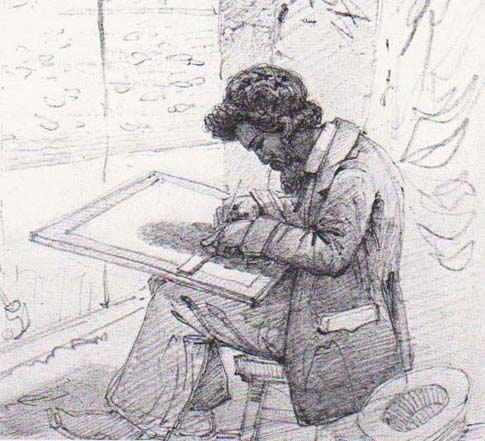
After a conversation on archaeology and drawing, which took place in the MePri in 2006, this rather historical contribution is a second inquiry in the relationship between art, visual documentation and archaeology. I. Drawing an excavation In a series of drawings of the archaeological work at the ancient hill of Munbaqa in Syria I tried […]
-
Documenting an excavation , Tell Munbaqa, Syria, Sept. 2010
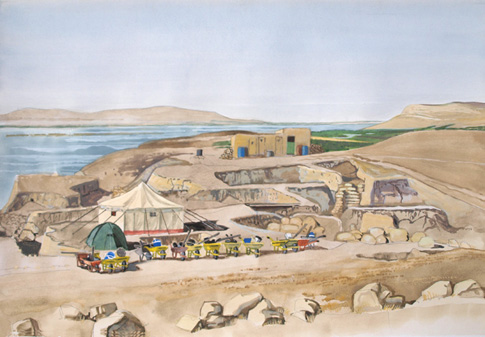
In this series of drawings and paintings of the archaeological work at the ancient hill of Munbaqa in Syria Dutch artist and archaeologist Theo de Feyter caught the situations and atmosphere which are characteristic for this kind of activity. The images depict the working procedures of the Syrian labourers and the members of the excavation […]
-
“Air Line” or The Unchosen Motif
The Dutch word “onverkoren” is a fictive, ambiguous term. It can mean both “not selected” and “not chosen.” Motifs not selected are motifs I came upon by chance. I am a painter who works outdoors, “in front of the motif.” My search for motifs in nature or in the city is influenced by the usual […]
-
“You Draw What You Know” – In conversation with Theo de Feyter
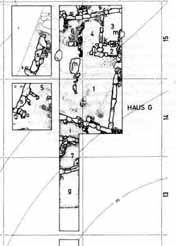
A conversation on archaeology and drawing MePri, Düsseldorf, 12/16/2006 Alexander Roob: In addition to your art studies, you also completed a period of studies in archaeology and then worked as a professional archaeologist. Perhaps you can start with a bit of biographical information. Theo de Feyter: I first studied art at the Rijksakademie in Amsterdam, […]